Median arcuate ligament syndrome
Quick Search
Summary
Median arcuate ligament syndrome (MALS), also known as coeliac artery compression syndrome, is a condition that is characterised by abdominal pain, usually felt from below the ribs to the pelvis. MALS is caused by the compression of the body’s coeliac artery by the median arcuate ligament.
The median arcuate ligament is a band of tissue under the diaphragm that connects the diaphragm to the spine.1 The coeliac artery is a blood vessel that supplies blood to multiple upper abdominal organs (such as the gastrointestinal tract, liver and spleen), and normally sits below the median arcuate ligament.5,6
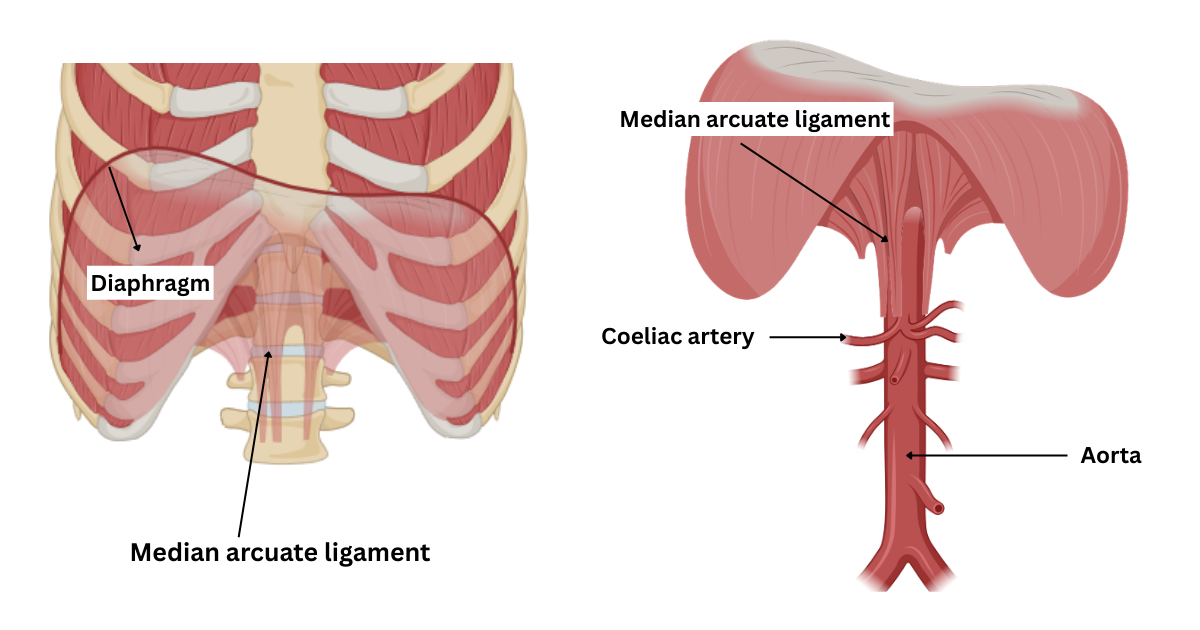
Median arcuate ligament and coeliac artery
It can be common for the median arcuate ligament to compress (press against) the coeliac artery, and most people do not develop any symptoms.2,3 In some individuals, the compression leads to symptoms such as abdominal pain, this is known as MALS. It is not well understood why some individuals develop MALS and some do not.2
MALS is much more common in young adult females.2
Synonyms and Classifications
Synonyms: MALS, Celiac artery compression syndrome, Dunbar syndrome, Harjola-Marable syndrome.3,4
Universal rare disease classifications provide a common language for recording, reporting and monitoring diseases. Please visit the Rare Disease Classifications page for more information about these internationally recognised classifications.
Symptoms
Common symptoms of MALS include chronic abdominal pain, nausea, vomiting, bloating and diarrhea.1,3 The pain often worsens after a meal, when breathing out (expiration), and during exercise.1,3,6 The pain may cause individuals to avoid eating, which can lead to significant weight loss.5
Please speak to your medical team to learn more about the signs and symptoms of MALS.
Disability Impacts
Rare diseases are often serious and progressive, exhibiting a high degree of symptom complexity, leading to significant disability. Majority of the estimated two million Australians living with a rare disease meet the Australian Government’s definition for disability (in accordance to the Australian Public Service Commission and Australian Bureau of Statistics), and many experience severe and permanent disability impacts. If you or someone you care for is experiencing disability-related impacts from a rare condition, please speak with a health or disability professional for advice. Information about relevant disability support can be found at the RARE Portal’s Disability Support Information page.
Cause and Inheritance
MALS is caused by the compression of coeliac artery by the median arcuate ligament. The compression can reduce blood flow and irritate nearby nerves, leading to inflammation and abdominal pain.1-5
This compression may occur due to:3,5
- anatomical differences present at birth (the median arcuate ligament sits unusually low, or if the coeliac artery is positioned higher than usual)
- other conditions that can increase compression on the coeliac artery and nerves, such as Ehlers-Danlos syndrome (due to abnormal flexibility), problems with spine curvature such as scoliosis
- trauma or injury
Diagnosis
Diagnosis of MALS may be made based on:2,5
- medical history
- physical examination
- blood and urine test
- food allergy testing, including for coeliac disease
- imaging studies such as endoscopy, ultrasound, computed tomography (CT) scan
- gastrointestinal motility testing
- gastric exercise tonometry to assess blood flow to the stomach
MALS is often a diagnosis of exclusion, which means other possible causes of abdominal pain need to be ruled out.2
As part of the diagnostic process, doctors may do a differential diagnosis, where they rule out other conditions that have similar symptoms, such as coeliac disease, inflammatory bowel disease, intestine obstructions, gallbladder disease, appendicitis, hepatitis, gastritis, peptic ulcer disease, pancreatitis, splenomegaly, endometriosis, hernias, atherosclerosis, mesenteric ischemia, renal artery stenosis, and others.1-4
Please speak to your medical team to learn more about the available diagnostic pathways for MALS.
Treatment
There is currently no curative treatment for MALS. Treatment is targeted at reducing the compression of coeliac artery and relieving pain.1 This may include:2,5
- management of pain
- coeliac plexus block where local anaesthetic is injected into the coeliac plexus (nerves in the upper abdomen that send pain signal from the abdomen to the brain) to relieve abdominal pain
- surgery to decompress coeliac artery and remove coeliac plexus. In some cases, further procedures such as coeliac artery reconstruction may be performed.
Please speak to your medical team to learn more about the possible treatment or management options for your condition. Treatment will depend on an individual’s specific condition and symptoms. It is also important to stay connected to your medical team so that you can be made aware of any upcoming clinical trial opportunities. For many rare diseases, treatment options may be limited. Participation in a clinical trial may provide access to new or emerging therapies.
Clinical Care Team
Healthcare professionals involved in the care of individuals with MALS may include general practitioners (GP), paediatricians, gastroenterologists, vascular surgeons, radiologists, pain specialists.2 The need for different healthcare professionals may change over a person’s lifetime and extend beyond those listed here.
Clinical care for rare diseases often involves a multidisciplinary team of medical, care and support professionals. Please note that the information provided here is as a guide and that RVA does not necessarily monitor or endorse specific clinics or health experts.
This may not be applicable to all rare diseases but for many, palliative care services may be relevant and useful. Palliative care services are available for people (adults, children and their families) living with a life-limiting illness and is not only for end-of-life care. It can also help at any stage of illness from diagnosis onwards, and will look different for different people. Palliative care services provide assistance, support, resources and tools to help people manage their illness and the symptoms, ease pain, and improve comfort and quality of life. If this is relevant to you and you wish to find out more information about palliative care and how it can help you, please visit:
Clinical Care Guidelines
We are not aware of any clinical care guidelines for MALS in Australia or internationally. If you know of any relevant care guidelines, please let us know via the Contribute page.
Emergency Management
Individuals living with rare diseases may have complex medical issues and disabilities, which are not always visible. It is often useful to refer to their medical history as well as personal information such as a medical card, doctor’s letter, or if available, a rare disease passport, for relevant information.
In addition, individuals, their parents, families and carers often develop extensive expertise on their specific rare disease. It is important to recognise that they can contribute valuable knowledge about their rare condition. Rare diseases often impact individuals differently, so it’s important to consider a person’s lived experience.
Research
There are specific considerations around participating in rare disease research, including clinical trials. It is important to be mindful of issues such as data privacy, research ethics, consent and differences in research regulations between Australia and other countries. For more information, please visit the RARE Portal’s Considerations for Participating in Health and Medical Research page.
If you are interested in finding clinical trials for your condition, please visit the following websites; however, there may not be any clinical trials available:
It is best to discuss your interest in research, including clinical trials, with your medical team to determine suitability and eligibility.
Rare Disease Organisation(s)
Australian Organisation:
We are not aware of any rare disease organisations for MALS in Australia. If you are aware of any Australian organisations, please let us know via the Contribute page.
International Organisation:
National MALS Foundation (United States of America)
Website: https://www.malsfoundation.org/
Please note that RVA does not monitor or endorse each group/organisation’s operational governance and activities. When engaging with a group, please consider the information on the RARE Portal’s Finding Helpful Peer and Community Supports page.
Lived Experience
MALS varies between individuals, and each person’s experience is unique.
National MALS Foundation: Patient Stories have personal stories of people living with MALS.
If you would like to share your personal story with RVA, please visit the Rare Voices Australia: Share Your Story page. RVA will consider your story for publishing on our website and inclusion on the RARE Portal.
Support Services and Resources
For information on available government and social services that provide support for individuals with a rare disease, please visit the National and State Services pages.
Mental Health
People living with a rare disease often face unique challenges such as diagnostic delays, misdiagnoses, limited treatment options, and limited access to rare disease specialists and support. These challenges may impact people’s emotional wellbeing and quality of life. Many find it helpful to seek mental health and wellbeing support to cope with ongoing stress and uncertainty. Connecting with people who have shared experiences through a support group may also be helpful. Information about relevant mental health and wellbeing support can be found at:
- Mental Health and Wellbeing Support for Australians Living with a Rare Disease
- The National and State Services pages underneath the ‘Mental Health’ sections listed
Other Information
Further information relevant to MALS can be found at:
Useful Links for Healthcare Professionals
References
- Upshaw W, Richey J, Ravi G, et al. Overview of Median Arcuate Ligament Syndrome: A Narrative Review. Cureus. 2023;15(10):e46675. doi:7759/cureus.46675
- Lal V, Guazzo L. Median arcuate ligament syndrome: When to consider the diagnosis and management options. AJGP. 2024;53(12). doi:31128/AJGP-11-23-7045
- Saleem T, Katta S, Baril DT. Celiac Artery Compression Syndrome. Updated 26 April 2023. In: StatPearls [Internet]. Treasure Island (FL): StatPearls Publishing; 2025 Jan-. Available from: https://www.ncbi.nlm.nih.gov/books/NBK470601/
- National Organisation for Rare Disorders (NORD). Median Arcuate Ligament Syndrome. Updated 18 July 2025. Accessed 1 December 2025. https://rarediseases.org/rare-diseases/median-arcuate-ligament-syndrome/
- Park WM, Budik S, Malanowski A, Aboumerhi H, Khaitan L. Vascular Disease Patient Information Page: Median arcuate ligament syndrome (MALS). Vascular Medicine. 2025;30(5):654-658. doi:1177/1358863X251363902
- Hernandez A. Elsevier. Osmosis. Updated 5 March 2025. Accessed 1 December 2025. https://www.osmosis.org/answers/median-arcuate-ligament-syndrome
Contributors
This page has been developed by Rare Voices Australia (RVA)’s RARE Portal team.
If you are aware of any additional information that may benefit stakeholders with an interest in this page, or if you notice any broken links or inaccurate information, please let us know via the Contribute page.