Leukodystrophy (Group of conditions)
Quick Search
- Summary
- Synonyms and Classifications
- Symptoms
- Disability Impacts
- Cause and Inheritance
- Diagnosis
- Treatment
- Clinical Care Team
- Clinical Care Guidelines
- Emergency Management
- Research
- Rare Disease Organisation(s)
- Lived Experience
- Support Services and Resources
- Mental Health
- Other Information
- Useful Links for Healthcare Professionals
Summary
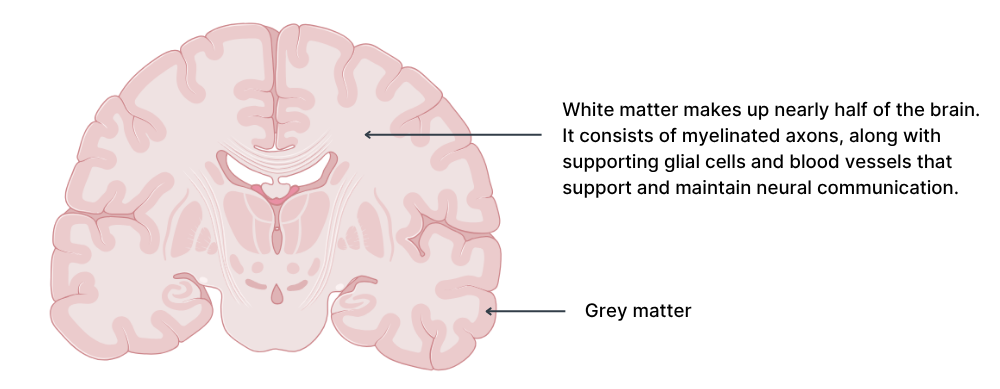
Leukodystrophy is a group of genetic conditions that affect the white matter in the brain and spinal cord.1,2 The white matter is essential for communications (electric signalling) between different parts of the brain.3 It is mainly made up of bundles of nerve fibres/axons (that send electric signalling between nerve cells), glial cells (different specialised cells that provide support, nutrients and protection), and blood vessels. Axons have a protective layer called myelin, that speeds up signalling between nerve cells. Abnormal changes or damage to the white matter can lead to neuron degeneration and impact brain function.3
There are currently over 60 types of leukodystrophy. With the advancement of research and genetic testing, new types of leukodystrophy are being identified over time. Leukodystrophy was previously thought to be caused by abnormalities in the myelin but now it is recognised that many leukodystrophy conditions also result from abnormalities in different parts of the white matter.1,4
Leukodystrophy can affect people of different ages. Earlier-onset leukodystrophy usually present with more severe symptoms and progress more rapidly.4 Leukodystrophy can affect multiple parts of the body, impacting development, movement, vision, speech, eating, thinking and other brain functions.5,6
Synonyms and Classifications
Synonyms: hereditary white matter disorders, inherited leukoencephalopathies, degeneration of white matter of brain, hypomyelinating leukodystrophy (hld).6,7
Universal rare disease classifications provide a common language for recording, reporting and monitoring diseases. Please visit the Rare Disease Classifications page for more information about these internationally recognised classifications.
Please refer to the individual leukodystrophy for their specific classifications.
Symptoms
Depending on the type and genetic changes, leukodystrophy has a wide range of symptoms and severity. Symptoms of leukodystrophy may appear shortly after birth, or develop later in childhood or adulthood.4,8 Symptoms often progressively worsen over time.1
Some common symptoms of leukodystrophy include:2,5,9
- abnormalities in muscle tone and muscle control, such as dystonia (uncontrolled muscle contractions), ataxia (impaired balance) and spasticity (muscle stiffness). This can affect daily movement (frequent falls, and clumsy gait) and cause chronic pain.
- cognitive impairment such as developmental delay and behavioural attributes (inattention, irritability, hyperactivity, and aggression).5 In adults, this may look like dementia with slowed thinking and memory problems.
- dysarthria (slurring of speech) and language impairment5
- dysphagia (issues with feeding and swallowing), and gastro-oesophageal reflux. These can lead to malnutrition and aspiration pneumonia (lung infection caused by foreign materials such as food, liquid, or saliva entering the airways).
- seizures and/or epilepsy
- peripheral neuropathy leading to numbness, nerve pain and weakness
- sleep disturbances
- urinary problems such as urinary incontinence and urinary tract infections
- constipation or faecal incontinence
- bone abnormalities such as scoliosis, hip dysplasia and hip dislocation
- vision impairment
Leukodystrophy may also affect other parts of the body such as the endocrine system (that regulates hormones), autonomic nervous system (that controls involuntary functions such as heart rate, breathing, body temperature etc.), autoimmune system, reproductive system, the heart, lungs, skin, eyes, and teeth.5,9
There may be other symptoms not listed here. Please speak to your medical team to learn more about the symptoms and health implications for a specific type of leukodystrophy.
Disability Impacts
Rare diseases are often serious and progressive, exhibiting a high degree of symptom complexity, leading to significant disability. Majority of the estimated two million Australians living with a rare disease meet the Australian Government’s definition for disability (in accordance to the Australian Public Service Commission and Australian Bureau of Statistics), and many experience severe and permanent disability impacts. If you or someone you care for is experiencing disability-related impacts from a rare condition, please speak with a health or disability professional for advice. Information about relevant disability support can be found at the RARE Portal’s Disability Support Information page.
Cause and Inheritance
Leukodystrophy is a group of genetic conditions. Each type of leukodystrophy is caused by different disease-causing genetic changes (variants) that leads to abnormal development or damage to components of the white matter.6
These genetic variants are typically inherited (passed down from parents). Depending on the type, it can be inherited in different manners such as autosomal recessive, autosomal dominant, X-linked, and mitochondrial.8 In a small number of cases, these genetic variants occur randomly (de novo) prior to birth and is not inherited from their parents. Please visit Centre for Genetics Education: Genetic inheritance for more information about the different inheritance patterns.
Please refer to the individual leukodystrophy for their specific cause and inheritance.
If you would like to learn more about the inheritance and impact of this condition, please ask your doctor for a referral to a genetic counsellor. Genetic counsellors are qualified allied health professionals who can provide information and support regarding genetic conditions and testing. More information about genetic counselling can be found at:
- Information on Genetic Services
- The National and State Services pages underneath the ‘Genetic Counselling’ sections listed
Diagnosis
Diagnosis of leukodystrophy may be made based on:4,8
- Family history
- Physical examination
- Neurological examination to check the function of the brain and nervous system
- Cognitive testing to look at the impact of the condition
- Magnetic resonance imaging (MRI) that shows abnormalities of the white matter or brain structures
- Biochemical blood or urine tests
- Genetic testing through a blood test, cheek swab or other method
Many people with leukodystrophy have testing for other conditions that look similar to leukodystrophy, so it is common for people to be referred for other tests such as a lumbar puncture to perform analysis of the cerebrospinal fluid, examination of the eyes, or other special tests.
The diagnostic process and criteria for specific leukodystrophy conditions may differ. Please speak to your medical team to learn more about the available diagnostic pathways for a specific type of leukodystrophy.
Treatment
There is currently no curative universal treatment for all types of leukodystrophy. Treatment will depend on the type of leukodystrophy and an individual’s symptoms. Treatment is usually targeted at managing symptoms and supportive care, this may include:4,5
- medication to manage abnormal muscle tone and spasms
- management of bone abnormalities; this may require surgery in some cases
- management of respiratory function such as infection prevention, airway maintenance and mechanical support to help with breathing
- management of pain
- management of seizures
- management of sleep
- management of nutritional needs and swallowing issues, which may include insertion of gastronomy tubes
- physiotherapy
- occupational therapy
- mobility aid such as orthotics, braces, gait trainers, and walkers
- speech therapy and the use of augmentative and alternative communication (AAC)
- management of hormones imbalances
- management of vision and eye abnormalities
- management of heart problems
For some types of leukodystrophy, haematopoietic stem cell (bone marrow) transplant and gene therapy may slow down disease progression or may be curative.4,8 This may not be the case for everyone.
Please speak to your medical team to learn more about the possible treatment or management options for your condition. Treatment will depend on an individual’s specific condition and symptoms. It is also important to stay connected to your medical team so that you can be made aware of any upcoming clinical trial opportunities. For many rare diseases, treatment options may be limited. Participation in a clinical trial may provide access to new or emerging therapies.
Clinical Care Team
Healthcare professionals involved in the care of people with leukodystrophy may include general practitioners (GP), paediatricians, neurologists, gastroenterologists, urologists, physiotherapists, occupational therapists, orthopaedic surgeons, speech pathologists, endocrinologists, cardiologists, ophthalmologists.5 The need for different healthcare professionals may change over a person’s lifetime and extend beyond those listed here.
Clinics:
- White Matter Disorders Clinic at the Royal Children’s Hospital (Victoria) runs on a monthly basis. The clinic provides comprehensive assessment and diagnostic testing where needed for children with leukodystrophies and white matter disorders. A GP or specialist referral is required.
- The Adult Leukodystrophy Clinic at the Westmead Hospital (New South Wales) is coordinated through the Department of Genetic Medicine and runs every second month. The specialists in the clinic can provide assessment, diagnostic testing and management for adults with suspected or confirmed leukodystrophies. A GP or specialist referral is required.
Clinical care for rare diseases often involves a multidisciplinary team of medical, care and support professionals. Please note that the information provided here is as a guide and that RVA does not necessarily monitor or endorse specific clinics or health experts.
This may not be applicable to all rare diseases but for many, palliative care services may be relevant and useful. Palliative care services are available for people (adults, children and their families) living with a life-limiting illness and is not only for end-of-life care. It can also help at any stage of illness from diagnosis onwards, and will look different for different people. Palliative care services provide assistance, support, resources and tools to help people manage their illness and the symptoms, ease pain, and improve comfort and quality of life. If this is relevant to you and you wish to find out more information about palliative care and how it can help you, please visit:
Clinical Care Guidelines
We are not aware of any clinical care guidelines for leukodystrophy as a whole in Australia. If you know of any relevant care guidelines, please let us know via the Contribute page.
The following guidance is available from international experts outside Australia; however, there may be information that is not relevant or applicable to the Australian context, and may not be up to date:
- Adult-onset leukodystrophies: a practical guide, recent treatment updates, and future directions developed by medical experts from United States of America, India and United Kingdom, published in 2023.
- Revised consensus statement on preventive and symptomatic care of leukodystrophy patients developed by the Global Leukodystrophy Initiative Consortium (GLIA) including leukodystrophy medical experts from United States and Canada, published in 2017.
Please refer to the individual leukodystrophy for their specific clinical care guidelines if available.
Emergency Management
Individuals living with rare diseases may have complex medical issues and disabilities, which are not always visible. It is often useful to refer to their medical history as well as personal information such as a medical card, doctor’s letter, or if available, a rare disease passport, for relevant information.
In addition, individuals, their parents, families and carers often develop extensive expertise on their specific rare disease. It is important to recognise that they can contribute valuable knowledge about their rare condition. Rare diseases often impact individuals differently, so it’s important to consider a person’s lived experience.
Research
The Australian Leukodystrophy Clinical and Research Program is a collaboration between medical research institutes, hospitals and universities around Australia including: the Royal Children’s Hospital, the Murdoch Children’s Research Institute, the University of Queensland, the University of New South Wales and the Women’s and Children’s Hospital (South Australia). They also maintain The Australian Leukodystrophy and White Matter Disorders Registry.
Rare Disease Organisation(s)
Australian Organisation:
Leukodystrophy Australia
Website: https://leuko.org.au/
Leukodystrophy Australia is the national peak organisation representing people impacted by leukodystrophy. Leukodystrophy Australia collaborates with local, national and international stakeholders to advance the care of their members, improve quality of life and ultimately seek a cure for leukodystrophy.
Please note that RVA does not monitor or endorse each group/organisation’s operational governance and activities. When engaging with a group, please consider the information on the RARE Portal’s Finding Helpful Peer and Community Supports page.
Lived Experience
Leukodystrophy varies between individuals, and each person’s experience is unique.
Leukodystrophy Australia: Our People Our Stories has personal stories of people living with leukodystrophy.
Personal story shared with RVA: Ryan’s story
If you would like to share your personal story with RVA, please visit the Rare Voices Australia: Share Your Story page. RVA will consider your story for publishing on our website and inclusion on the RARE Portal.
Support Services and Resources
For information on available government and social services that provide support for individuals with a rare disease, please visit the National and State Services pages.
Mental Health
People living with a rare disease often face unique challenges such as diagnostic delays, misdiagnoses, limited treatment options, and limited access to rare disease specialists and support. These challenges may impact people’s emotional wellbeing and quality of life. Many find it helpful to seek mental health and wellbeing support to cope with ongoing stress and uncertainty. Connecting with people who have shared experiences through a support group may also be helpful. Information about relevant mental health and wellbeing support can be found at:
- Mental Health and Wellbeing Support for Australians Living with a Rare Disease
- The National and State Services pages underneath the ‘Mental Health’ sections listed
Other Information
Further information on leukodystrophy can be found at:
- Australian Leukodystrophy Clinical and Research Program: General leukodystrophy resources and type specific resources
- Better Health Channel: Leukodystrophy
- United Leukodystrophy Foundation: Leukodystrophies
- The Paris Adult Leukodystrophy Centre: Leukodystrophies
- Genetic and Rare Diseases (GARD) Information Center: Leukodystrophy
- National Organization for Rare Disorders (NORD): Leukodystrophy
Useful Links for Healthcare Professionals
Childhood Dementia Knowledgebase – a relational database with key statistics for each of the 100+ conditions that cause childhood dementia, many of which are leukodystrophy conditions.
References
- van der Knaap MS, Bugiani M. Leukodystrophies: a proposed classification system based on pathological changes and pathogenetic mechanisms. Acta Neuropathol. 2017;134, 351–382. https://doi.org/10.1007/s00401-017-1739-1
- Keller SR, Mallack EJ, Rubin JP, et al. Practical Approaches and Knowledge Gaps in the Care for Children With Leukodystrophies. Journal of Child Neurology. 2020;36(1):65-78. https://doi.org/10.1177/0883073820946154
- Fields RD. Neuroscience. Change in the brain’s white matter. Science. 2010;330(6005):768-769. https://doi.org/10.1126/science.1199139
- Muthusamy K, Sivadasan A, Dixon L, et al. Adult-onset leukodystrophies: a practical guide, recent treatment updates, and future directions. Front. Neurol. 2023;14. https://doi.org/10.3389/fneur.2023.1219324
- Adang LA, Sherbini O, Ball L, et al. Revised consensus statement on the preventive and symptomatic care of patients with leukodystrophies. Mol Genet Metab. 2017;122(1-2):18-32. https://doi.org/10.1016/j.ymgme.2017.08.006
- National Organisation for Rare Disorders (NORD). Leukodystrophy. Updated 22 March 2022. Accessed 12 February 2026. https://rarediseases.org/rare-diseases/leukodystrophy/
- Genetic and Rare Diseases (GARD) Information Center. Leukodystrophy. Accessed 12 February 2026. https://rarediseases.info.nih.gov/diseases/6895/leukodystrophy
- Ceravolo G, Zhelcheska K, Squadrito V, et al. Update on leukodystrophies and developing trials. J Neurol. 2024;271(1):593-605. https://doi.org/10.1007/s00415-023-11996-5
- Parikh S, Bernard G, Leventer RJ, et al. A clinical approach to the diagnosis of patients with leukodystrophies and genetic leukoencephelopathies. Mol Genet Metab. 2015;114(4):501-515. https://doi.org/10.1016/j.ymgme.2014.12.434
Contributors
This page has been co-developed by Rare Voices Australia (RVA)’s RARE Portal team in consultation with Leukodystrophy Australia and input from Dr Michel Tchan (Clinical and Metabolic Geneticist, Head of Department of Genetic Medicine at Westmead Hospital, NSW) and Dr David Manser (Neurologist and Staff Specialist, Department of Genetic Medicine at Westmead Hospital, NSW), published on 14 May 2026.
If you are aware of any additional information that may benefit stakeholders with an interest in this page, or if you notice any broken links or inaccurate information, please let us know via the Contribute page.